

Fountain Pen Network-Philippines, Inc. President Leigh Reyes with urushi artist Hiroko Makino and Toru Takezawa of Bokumondoh. Photo by John Raymond Lim.
Another successful Manila Pen Show was concluded last March 16-17, 2024 at the Holiday Inn & Suites Makati! This is the fourth pen show organized by Fountain Pen Network-Philippines, Inc. Tickets were sold at Php 350 each, with proceeds from ticket and MPS-branded merchandise sales benefitting Save The Children. The Manila Pen Show has been supporting Save The Children since 2018. This year we welcomed veteran exhibitors from the Philippines, Singapore, Japan, and Malaysia, and were joined by new exhibitors from the Philippines, Hong Kong, Japan and the USA.
Among the vendors were:
Aesthetic Bay (Singapore)
Alden Castañeda (Philippines)
Bokumondoh (Japan, new)
Bungubox (Japan, new)
Cat Custom Crafts (Philippines, new)
DeSara Pens (Philippines, new)
Endless Pens (USA, new)
Everything Calligraphy (Philippines)
Gav n Sav (Philippines)
Gira Leather (Philippines)
Glassophy (Hong Kong)
Imma Frias-Fua [calligrapher] (Philippines, new)
John Raymond Lim Nibworks [nibmeister] (Philippines)
JP’s Pen Spa and Nibworks [nibmeister] (Philippines)
Kasama Pens (Philippines)
KustomMagz Creations (Philippines)
Lamy Philippines (Philippines)
Leather Luxe PH (Philippines)
Matthew Chen Nibworks [Pactagon nibmeister] (USA, new)
Musubi (Singapore)
Muze Pens (Hong Kong)
Nagasawa (Japan, new)
ON Inks (Philippines)
Pen Gallery (Malaysia)
Pengrafik (Philippines)
Peter Bangayan [Diamine distributor] (Philippines)
Promise of Spring (Philippines, new)
Sailor Pens (Japan)
Scribe (Philippines)
Sey Pens (Japan, new)
Stationer Extraordinaire (Philippines)
Stylo Art Karuizawa (Japan, new)
Sunny Koh of Straits Pens [nibmeister] (Singapore)
Tin Chan Ceramics (Philippines, new)
The Manila Penography (Philippines, new)
Toyooka Craft (Japan)
Troublemaker Inks (Philippines)
Vinta Inks (Philippines)
Vintage Pens by Guia (Philippines)

Exhibitor site map. @manilapenshow IG.

Scan the QR code to see vendor information, location and modes of payment.

Volunteers at the registration table. Photo by John Raymond Lim.

Volunteers at the registration table. Photo by Kailash Ramchandani.

Volunteers at the registration table. Photo by Kailash Ramchandani.

Volunteers at the registration table. Photo by Kailash Ramchandani.

Stamp station. Photo by Anne Tamondong.

Volunteers at the merchandise table. Photo by Kailash Ramchandani.

Saturday, March 16. Photo by Ernesto Tabujara III.

Sunday, March 17. Photo by Ernesto Tabujara III.

Pens from Aesthetic Bay. Photo by Ernesto Tabujara III.

Pelikan pens from Aesthetic Bay. Photo by Ernesto Tabujara III.

Tan Fong Kum (center), Connie Tay (left) and Iyan Tan (right) of Aesthetic Bay. Photo by John Raymond Lim.

Connie and Iyan of Aesthetic Bay with Fountain Pen Network-Philippines, Inc. VP Lorraine Castañeda. Photo by John Raymond Lim.

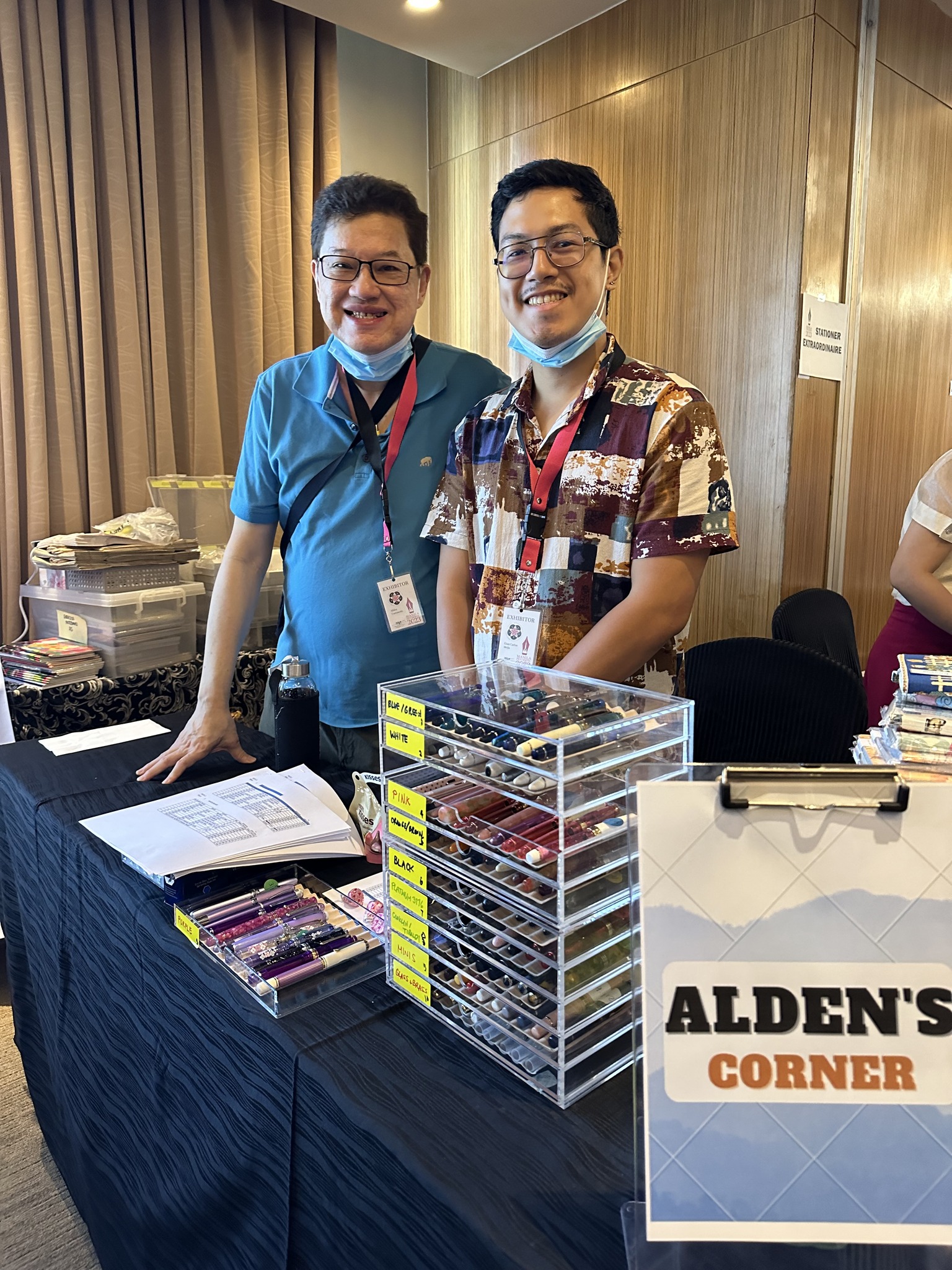
Inks at Alden’s Corner. Photo by Ernesto Tabujara III.

Alden Castañeda of Alden’s Corner. Photo by John Raymond Lim.

Toru Yamazaki of Toyooka Craft setting up his booth. Photo by John Raymond Lim.

Toyooka Craft pen rests. Photo by Raymund Niño Bumatay.

Toyooka Craft. Photo by John Raymond Lim.

Handmade pens from Stylo Art Karuizawa. Photo by Jose Dalisay, Jr.

Shuko Kazuno of Stylo Art Karuizawa. Photo by Jose Dalisay, Jr.

Motoshi and Shuko Kazuno of Stylo Art Karuizawa. Photo by John Raymond Lim.

Toru Yamazaki of Toyooka Craft, Kailash Ramchandani of Pengrafik, and Fountain Pen Network-Philippines VP Lorraine Castañeda. Photo by John Raymond Lim.

Pengrafik’s Manila Pen Show 2024 exclusive, the Gioia fountain pen. Photo by Kailash Ramchandani.

Atelier F titanium F3 pens at Pengrafik. Photo by Ernesto Tabujara III.

Pengrafik’s booth. Photo by Jose Dalisay, Jr.

Musubi journals. Photo by John Raymond Lim.

Musubi Seigaiha pen cases and Peruvian handbound journal. Photo by Ronin Bautista.

Among Musubi’s products were journals and pen cases. Photo by Ronin Bautista.

Daryl Lim of Musubi, with Amanda Gorospe. Photo by John Raymond Lim.

Kasama Una and Tala pens in “Pulo” colorway. Photo from @kasamaph IG.

Kasama Pens booth. Photo by Ernesto Tabujara III.

Kustom Magz “Lazyboy” brass pen rest. Kustom Magz also makes rollstops for Kasama pens. Photo by Marco Kris Magallona.

Marco Kris Magallona (right) of Kustom Magz Creations, with client and Kasama Una with rollstop. Photo by Kailash Ramchandani.

Alvin Arcillas (top left), Mark del Rosario (center) and Nikki Bisquera (right) of Kasama Pens and Marco Kris Magallona (bottom left) of Kustom Magz Creations. Photo by John Raymond Lim.

One of two Everything Calligraphy x Franklin-Christoph collaboration pens. Photo from @everythingcalligraphy IG.

Vinta Inks’ Summer Cocktails Collection. Photo from @inksbyvinta IG.

Everything Calligraphy and Vinta Inks booths. Photo from Everything Calligraphy.

Everything Calligraphy display. Photo from Everything Calligraphy.

Jillian Joyce Tan of Everything Calligraphy and Vinta Inks. Photo by John Raymond Lim.

Kaweco Apricot Pearl for sale at Stationer Extraordinaire. Photo from @stationerextraordinaire IG.

Jeff Cua of Stationer Extraordinaire, with staff. Photo by Raymund Niño Bumatay.

Ingrid Cua of Stationer Extraordinaire. Photo by Kailash Ramchandani.

Ingrid Cua of Stationer Extraordinaire. Photo by Jeff Cua.

Four new colors of ON Inks. Photo by Onie Dychitan.

ON inks. Photo by Ernesto Tabujara III.

Onie Dychitan of ON Inks. Photo by John Raymond Lim.

Leather Luxe PH booth. Photo by Raymund Niño Bumatay.

On the bottom row are “University” themed custom pen cases by Leather Luxe. Photo by Raymund Niño Bumatay.

Raymund Niño Bumatay (right) of Leather Luxe PH, with Fountain Pen Network-Philippines founder Jose “Butch” Dalisay, Jr. Photo by Jose Dalisay, Jr.

Leather Luxe PH booth. Photo by Kailash Ramchandani.

Diamine Manila Pen Show 2024 exclusive ink set available from Peter Bangayan – 5am, 11am and 6pm. Photo by Bernie Paras Gan.

Peter Bangayan’s Diamine booth. Photo by Ernesto Tabujara III.

Diamine distributor Peter Bangayan. Photo by Kailash Ramchandani.

Pens from The Manila Penography. Photo by Ernesto Tabujara III.

Pens from The Manila Penography. Photo by Kailash Ramchandani.

Calvin Almazan and colleagues at The Manila Penography. Photo by John Raymond Lim.

The Gav n Sav exclusive Manila Pen Show 2024 pen wrap, or “buslo”. Photo by Lara Telan.

Lara Telan-Abad Santos of Gav n Sav. Photo by Kailash Ramchandani.

Lara Telan-Abad Santos (right) of Gav n Sav. Photo by John Raymond Lim.

Kobe inks from Nagasawa. Photo by Ronnel Tumangday / F/Primus Photography.

Pens from Nagasawa. Photo by Ernesto Tabujara III.

Team Nagasawa: Tsukamoto Masahiro, Kawai Manabu, Ryu Muyo . Photo by John Raymond Lim.

An assortment of LiveNotes stationery made from the last batch of Tomoe River paper, available from Pen Gallery. Photo by Kim Hoong Lai.

Pens from Pen Gallery. Photo by Ernesto Tabujara III.

Kim Hoong Lai (right), wife Hannah Low (center), and son Ken, of Pen Gallery. Photo by John Raymond Lim.

Customized Pilot Capless/Vanishing Points in urushi work by Bokumondoh. Photo from @bokumondoh IG.

Urushi artist Hiroko Makino (left) and Toru Takezawa (right) of Bokumondoh, on Day 2. Photo by Kailash Ramchandani.

Crowd of fans/customers at Bokumondoh’s booth. Items sold out! Photo by John Calixto.

Pens exclusively sold by Bungubox. Photo by Marj Lapid Nzal.

More pens and inks from Bungubox. Photo by Ernesto Tabujara III.

Bruce Eimon (left) and Kaoru Yamagishi (right) of Bungubox. Photo by John Raymond Lim.

Exquisite artisan glass pens by Glassophy. Photo from @glassophy_bunbou IG.

Glass pens from Glassophy. Photo by Ernesto Tabujara III.

Iris Au (left) and Siu-man Chan (right) of Glassophy. Photo by John Raymond Lim.

Troublemaker inks. Photo by Ernesto Tabujara III.

Troublemaker Inks booth. Photo by Kailash Ramchandani.

Team Troublemaker Inks: Kaiser Duragos, Gabriel Arnado and colleague. Photo by John Raymond Lim.

Gira Leather. Photo by Ronnel Tumangday / F/Primus Photography.

Leather pen cases from Gira Leather. Photo by Ernesto Tabujara III.

Team Gira Leather: Isabel Silva and Ram Guanlao. Photo by Kailash Ramchandani.

Some of the Parker Vacumatics available from Vintage Pens by Guia. Photo from @purposefulscribe IG.

Guia Bengzon (left) of Vintage Pens by Guia. Photo by Ernesto Tabujara III.

Vintage Pens by Guia, and Imma Frias-Fua’s booth. Photo by Jose Dalisay, Jr.

Guia Bengzon (left) of Vintage Pens by Guia, and calligrapher Imma Frias-Fua (right). Photo by Guia Bengzon.

Calligrapher Imma Frias-Fua’s booth had fountain pen-friendly stationery. Photo by Ernesto Tabujara III.

Calligrapher Imma Frias-Fua, with David Fua. Photo by Kailash Ramchandani.

Penlux x Muze Pens Delgado Galaxy – Manila Pen Show 2024 Exclusive. Photo from @muzepens IG.

Pierre Cardin Manila Pen Show exclusive, Intramuros Puspin Blue. Photo by Lexee Carlota.

The Muze Pens booth. Photo by Ernesto Tabujara III.

CP Ng (left) and Sophie Yu (right) of Muze Pens. Photo by John Raymond Lim.

A rainbow of pens from Promise of Spring. Photo by Ronnel Tumangday / F/Primus Photography.

A collaboration pen between Promise of Spring and Cat Custom Crafts. Photo by Tere Villano.

Theresa Villano (seated) of Promise of Spring, with Kristine Chan of Tin Chan Ceramics. Photo by Tere Villano.

Pen rests by Tin Chan Ceramics. Photo from Kristine Chan.

Endless Pens Manila Pen Show 2024 exclusive, the Opus 88 Pocket Pen in “Grumpy Ming-ming”. It is the Filipino version of their Grumpy Kitty series, illustrated by Raqui Magtibay, exclusively for HATCH by EndlessPens.. Photo by Micah Robles.

Endless Pens Manila Pen Show 2024 exclusive, Tailored Pen Company Essex 3-in-1 Coffee pen, designed by Micah Robles. Photo by Micah Robles.

Endless Pens booth. Photo by Micah Robles.

Team Endless Pens: Micah Robles, Raquel Magtibay, Adrianne Jane Patinio, Gabrielle Dimaranan, Kenneth Begonia, Alexandra Umali, Gabbigaile Tagala, and Kat Zialcita. Photo by Ronin Bautista.

Another collaboration pen by Promise of Spring and Cat Custom Crafts. Photo by Tere Villano.

Cat Custom Crafts booth. Photo from @cat.custom.crafts IG.

Alexandra Catanghal (right) of Cat Custom Crafts. Photo from Alexandra Catanghal.

Urushi and maki-e pens by Sey Pens. Photo by Ronnel Tumangday / F/Primus Photography.

The Sey Pens booth. Photo by Ernesto Tabujara III.

Satoru Takahashi of Sey Pens. Photo by Kailash Ramchandani.

Satoru Takahashi of Sey Pens. Photo by John Raymond Lim.

Mabui fountain pen at DeSara Pens booth. Photo by Pierre Albert Alora.

DeSara Pen booth. Photo by Ronin Bautista.

Pierre Albert Alora of DeSara Pens. Photo by Bernie Paras Gan.

Scribe’s booth. Photo by John Raymond Lim.

Pens at Scribe. Photo by Ernesto Tabujara III.

Sailor pens. Photo by Ernesto Tabujara III.

Sailor Ink Master Hidetoshi Takahashi (left) and Tetsuo Hisaka (right). Photo by John Raymond Lim.

Sailor Ink Master Hidetoshi Takahashi (right) and Tetsuo Hisaka (left). Photo by John Raymond Lim.

Team Scribe and Sailor. Photo from Scribe.

Lamy pens. Photo by Ernesto Tabujara III.

Lamy booth. Photo from Lamy Philippines.

People shopping at Lamy booth. Photo from Lamy Philippines.

Lamy booth. Photo by Kailash Ramchandani.

Sunny Koh of Straits Pens (left), JP Reinoso of JP’s Pen Spa & Nibworks (in peach), Matthew Chen of Pactagon (in olive), John Raymond Lim of John Lim’s Nibworks (right). Photo by Ronnel Tumangday / F/Primus Photography.

J.P. Reinoso of JP’s Pen Spa & Nibworks. He specializes in nib grinds for regular and high-end pens, and vintage pen repair. Photo by Ronin Bautista.

JP’s Pen Spa & Nibworks booth. Photo by Ernesto Tabujara III.

Straits Pens Manila Pen Show exclusive inks. Photo by Sunny Koh.

Sunny Koh of Straits Pens. He is a Richard Binder-trained nibmeister based in Singapore. He conducted workshops on nib maintenance and ink mixing. Photo by John Raymond Lim.

Sunny Koh of Straits Pens. Photo by Kailash Ramchandani.

Matthew Chen of Pactagon is a Yukio Nagahara (Sailor)-trained nibmeister based in the US. Photo by John Raymond Lim.

Matthew’s Nibworks booth. Photo by Ernesto Tabujara III.

Team Matthew: Nina Chen (left), David Chen (center) and Matthew Chen (right), at the Manila Pen Show 2024. Photo by John Raymond Lim.

John Raymond Lim of John Lim’s Nibworks. He specializes in nib grinds for regular and high-end pens, and general pen/nib repair. Photo by Jose Dalisay, Jr.

John Lim’s Nibworks booth. Photo by Ernesto Tabujara III.


Toni Santos and the kids of her Cursive Handwriting for Kids workshop. Photo by Gema Gonzales.

Jose “Butch” Dalisay, Jr. speaking at the panel discussion “Beyond the Pen: Ephemera and Accessories” on Day 2 of the Manila Pen Show 2024. Photo from Jose Dalisay, Jr.

Panel speakers Corito Mendoza (left), Raph Camposagrado (center) and Jose Dalisay, Jr. (right). Photo from Jose Dalisay, Jr.

Panel discussion. Photo by Kailash Ramchandani.

Jun Castro talks about pen storage and accessories. Photo by Kailash Ramchandani.

Panel speakers (L-R): Raffy Aquino, Corito Mendoza, Raph Camposagrado, Jose Dalisay, Jr., Augusto Toledo II, Jun Castro. Photo by Kailash Ramchandani.

The Manila Pen Show jelly bag is so roomy, all your shopping can fit! Photo by Nadja Stormborn.

The Manila Pen Show 2024 Wear Kindness Pen Meet Bag – when you want to bring all your pens and inks for show and tell. Photo by Corito Mendoza.

The Manila Pen Show logo sport shirt. Classy enough for days when you’re not feeling too formal. Photo by Lexee Carlota.

Lee Paje won a set of Vinta Inks in the raffle. Photo by Alice Salita.

Bernie Paras Gan won an Everything Calligraphy x Franklin-Christoph pen and Vinta ink. Photo by Alice Salita.

Everything Calligraphy x Franklin-Christoph collaboration pen glows in the dark! Photo by Bernie Paras Gan.

Eyen Paune won a Kasama pen in the raffle. Photo by Lorraine Castañeda.

Miriam Ragay won a Musubi handbound journal in the raffle. Photo by Lorraine Castañeda.

Visitors at the show: Historian Ambeth Ocampo (left) and artist June Dalisay (right). Photo by Jose Dalisay, Jr.

The Fountain Pen Network-Philippines board and organizers invited all the vendors to a Filipino dinner at Milky Way in Makati on Saturday. Photo by Lorraine Castañeda.

On Sunday, Marian Ong of Scribe and some FPN-P members had a Chinese dinner with Sailor’s Takahashi-san and Hisaka-san in Jade Garden. Photo by EG Dizon.

This year the Manila Pen Show was attended by over 1,600 visitors (including organizers, vendors and volunteers). We’d like to thank everyone for joining Fountain Pen Network-Philippines in spreading the love for fountain pens, inks, stationery and accessories in the country and in Southeast Asia! Many thanks to Holiday Inn & Suites Makati for being our home in 2019, 2023 and 2024. See you next year at the next Manila Pen Show, on March 15-16, 2025!
For more updates on the next Manila Pen Show, check out @manilapenshow on Instagram, and join Fountain Pen Network-Philippines group and Manila Pen Show group on Facebook.




 Personal Geographic